
Sergei Babayan walked to the piano Thursday evening and played Bach’s Aria from the Goldberg Variations. Extraordinarily slow. Almost suspended in time. Then thirty-five more pieces unfolded across two hours. At the end, as an encore, he played the Aria again—the same notes, but heard entirely differently because of what had come between.
The opening Aria moved at a pace that felt almost expressionistic. Babayan wasn’t interested in Bach’s proportions or historical accuracy. He was interested in what happens when you let a single line breathe without rushing. Each note arrived as if from a distance. The touch was light, almost tentative. When the pedal came in, it was barely there—just enough to let a note ring a fraction longer, to add weight, then releasing it almost immediately. You could hear him listening to the piano, not commanding it.
The Program as Conversation
What made the evening remarkable wasn’t the variety of the program but its coherence. Moving from Schubert to Schumann to Liszt to Ponce to Rachmaninov to Kreisler, there was no sense of jumping between worlds. Babayan seemed to understand something fundamental: that all these pieces were asking the same question—how does a voice live on an instrument that cannot sustain sound?
In the Schubert Lieder transcribed by Liszt, the answer became clear. Without a singing voice, the keyboard had to find other ways to convey emotion. In Gretchen am Spinnrade, Erlkönig, Ständchen, the piano didn’t imitate a singer. It confessed. The accompaniment figures became as important as the melody, sometimes more so. The music breathed through the silence between notes as much as through the notes themselves.
Babayan’s touch throughout was precise but never mechanical. When he used the pedal, it was with remarkable economy—enough resonance to give a note body, then cutting it off before it could blur into the next one. In Liebesleid, you heard two distinct voices singing together on the keyboard, each with its own breath, its own space. This wasn’t technical display. It was an understanding that clarity serves emotion better than decoration.
The first half lasted nearly an hour before applause returned. The audience had held back, creating a kind of collaboration in silence.
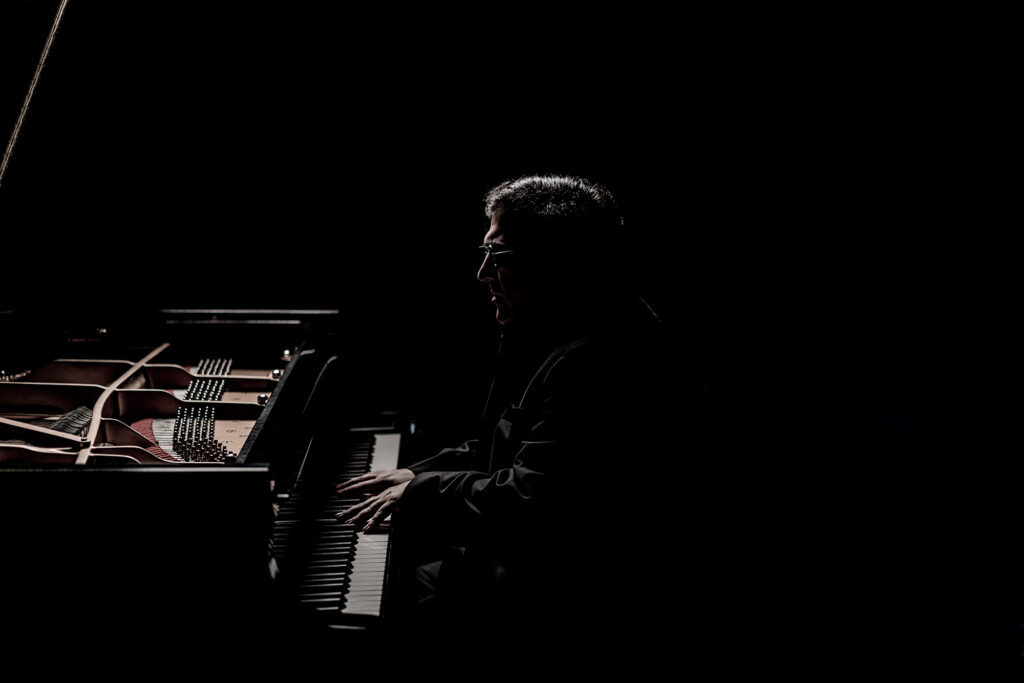
The Depths Open
The second half moved into quieter territory. Komitas, Mompou, Fauré, Poulenc—pieces that seemed to excavate something from beneath the surface. Babayan’s touch became even more refined. The pedal work more subtle. He was drawing you closer, insisting on attention.
Over the Rainbow, transcribed by Keith Jarrett, could have been sentimental. Instead, Babayan played it as something austere, almost stark. The melody was unmistakable but surrounded by space—existing because of the silence around it, not despite it. By the time he reached Les chemins de l’amour near the program’s end, the piano had become almost transparent. The notes were there, but they seemed to arrive from somewhere else entirely, as if Babayan had found a way to make the instrument disappear and leave only the music.
The Larger Point
What emerged across the evening was a musician working at the height of his powers, unbothered by perfection or display. Babayan moved through the program with a kind of measured grace—entering the stage without fanfare, moving between pieces with deliberation, each transition as carefully considered as the music itself. There was nothing rushed about him, nothing that suggested anxiety or the need to prove anything. Just a pianist, and friend of the Festival Bach de Montréal, who knew exactly what he wanted the evening to be and had the discipline to make it happen. The intermission has been reduced to 15 minutes.
The piano, as the program notes reminded us, is a percussion instrument masquerading as a singing one. For more than two centuries, piano makers have tried to solve this problem through engineering—soundboards, hammers, pedals, all designed to let wood and felt approximate what a human voice can do naturally. But engineering alone isn’t enough. The musician has to reveal the instrument’s soul. Thursday, Babayan did exactly that. His authority came not from virtuosity but from restraint—the kind of class act that makes everything look effortless because it actually was earned through complete mastery.