There was an unmistakable sense of anticipation in Salle Pierre-Mercure on Monday evening as Jakub Józef Orliński took the stage alongside pianist Michał Biel at the early dates of the Festival International Bach Montreal 2025. Seven years had passed since the Polish countertenor’s first Montreal appearance in 2018—a performance that had left audiences mesmerized at the Church of Andrew and St. Paul. Yet the artist returning to us this November was not simply repeating past glories. Instead, Orliński presented something more ambitious: a recital designed to dismantle, once and for all, the narrow expectations placed on the countertenor voice.
The program itself told this story. Moving fluidly between Bach’s introspective German sacred cantata, Handel’s theatrical Italian opera arias, Purcell’s English lyricism, and intimate Polish art songs by Baird and Karłowicz, Orliński constructed an argument through music—one that declares the countertenor is far more than the ornamental voice relegated to secondary roles in Baroque operas. This is a voice capable of profound emotional range, of lyrical depth and dramatic substance.
A Voice Reconsidered
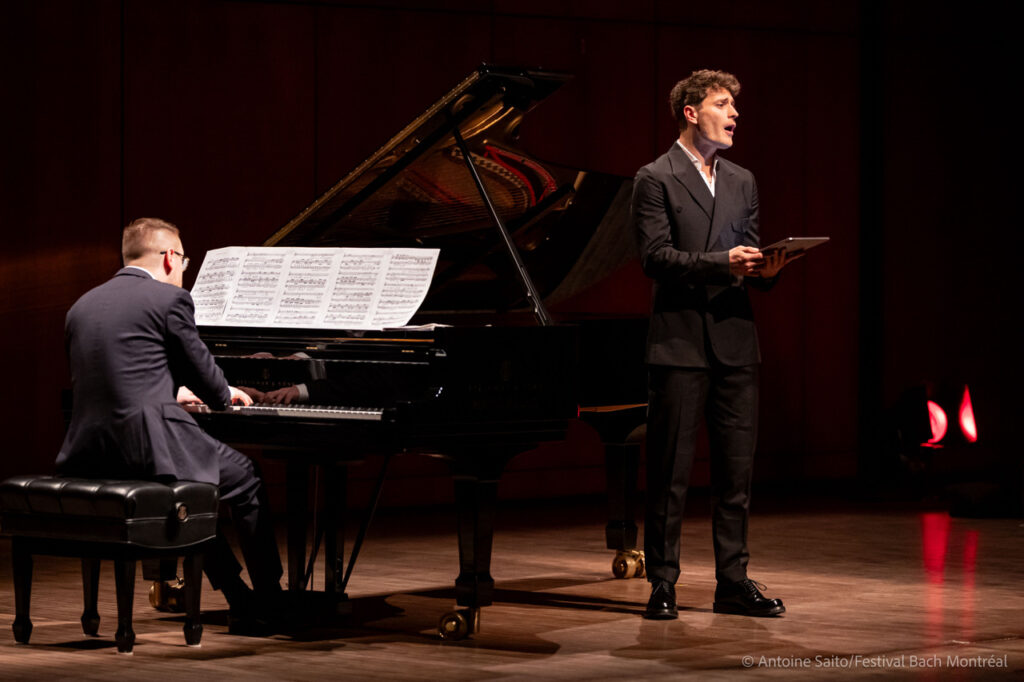
To understand what made Orliński’s performance so compelling Monday, you have to start with the voice itself. Unlike many countertenors, whose voices tend toward the lighter, more piercing end of the spectrum, Orliński’s tone carries an unusual warmth and roundness for someone working primarily in the head register. His falsetto stays even and controlled across his range, merely without the obvious breaks that can sometimes reveal the mechanics beneath a countertenor’s sound.
This tonal foundation was one of the evening’s real strengths. Yet the opening presented some challenges. Bach’s Wiederstehe doch der Sünde is a particularly demanding work: its almost conversational writing leaves little room for decoration, demanding direct communication without the ornamental lines that can help carry a piece forward. In this context, Orliński’s gift for subtle dynamics and long, graceful phrases sometimes worked against what the music actually needed. The aria’s meditation on resisting temptation felt, at moments, a touch too refined, its emotional rawness smoothed over by the sheer vocal beauty he naturally brings to sustained singing.
What emerged more powerfully in the pieces that followed was Orliński’s control over dynamics and expression. Moments that might have invited showy singing became instead careful studies in nuance. His high notes in the softer passages had an almost aching quality; his crescendos and decrescendos felt like natural breathing rather than something plotted in advance. Throughout, Michał Biel, his “partner-in-crime” as Orliński affectionately calls him in the program notes, was far more than a mere accompanist—he was a true partner, moving with alertness between simplicity and orchestral fullness, his touch ranging from subtle phrasing to surprising power. Biel never stepped back into the background; instead, he met Orliński at every turn, amplifying rather than supporting what the countertenor was doing.
The Theatrical Impulse and the Polish Reclamation
What sets Orliński apart from most countertenor specialists is his refusal to let Baroque tradition dictate who he is as an artist. This impulse, which has led him to breakdance at the Paris Olympics and collaborate on hip-hop arrangements of Handel, showed itself throughout Monday’s program as honest artistic conviction, not gimmick.
In the Handel opera arias, the dramatic passages from Rodelinda, Agrippina, and Alcina became real dramatic moments demandind character and storytelling. Technical brilliance in Baroque music can become a trap, a way to confuse skill with substance. Orliński clearly understands this. In “Furibondo spira il vento” from Partenope, you heard not a countertenor showing off but a character in genuine emotional extremity.
The program’s second half reclaimed his Polish roots. Here was a Polish artist, performing in a city with significant Polish cultural institutions (the support of the Consulate General of the Republic of Poland in Montreal was duly noted in the program), insisting that his instrument could sing his heritage just as naturally as it sang Handel. This was not exoticism or programming for diversity’s sake. Rather, it was an assertion that the countertenor voice belongs to no single tradition, no single composer, no single aesthetic moment in history.
His diction, even in technically demanding moment, kept the poetry both intelligible and expressive. The Festival’s decision to project the sung text alongside a French translation proved especially thoughtful, allowing the audience to follow the nuances of the poetry without distraction. Biel’s piano playing was notably tender here, creating a chamber-like closeness that contrasted beautifully with the more dramatic operatic world of the first half.

The Larger Moment
Orliński’s nearly thirteen million YouTube views from that 2017 Aix-en-Provence performance—Vivaldi’s “Vedro con mio diletto”—didn’t happen because audiences suddenly developed a taste for Baroque music. They happened because something about the way Orliński presents himself, his obvious joy in making music, his refusal to accept the usual limits of classical music, felt genuinely alive in a way the art form often struggles to be. The breakdancing, the hip-hop projects, the Break in Classic Festival he founded last August—these aren’t distractions from his “real” work. They’re extensions of an artistic vision that puts pleasure, exploration, and freedom at the center of music-making.
The packed hall, filled from parterre to balcony, rose to its feet at evening’s end, and the pair offered two encores, including Purcell’s “Strike the Viol”. Throughout the evening, Orliński’s brief remarks between pieces were warm and generous, guiding the audience through their listening with the ease of someone who enjoys connecting with people on scene.